Summary: School decorating is a specialist discipline that differs from standard commercial painting in several important ways. The physical environment of a classroom has a measurable impact on how children learn. Beyond aesthetics, education decorating requires DBS-checked tradespeople, low-VOC paint specifications suited to children, highly durable finishes capable of withstanding daily wear in high-traffic settings, and scheduling structured around the academic calendar.

Most people, when they think about painting and decorating, think about colour. Choosing the right shade for a classroom corridor, or refreshing tired walls in a school dining hall. But for any headteacher, facilities manager, or MAT operations lead responsible for commissioning decorating works, the colour choice is often the simplest part of the conversation.
School decorating carries a distinct set of requirements that separates it from general commercial painting. A decorator experienced in offices or retail spaces will not automatically be equipped to meet those requirements. Here is what genuinely makes educational painting different, and why it matters.
The Learning Environment Has a Measurable Impact on Academic Performance
The physical condition of a classroom is not a cosmetic concern. Research conducted by the University of Salford’s School of the Built Environment, published as the Clever Classrooms report, assessed 153 classrooms across 27 schools and collected performance data for 3,766 primary school pupils. The findings were significant: physical characteristics of the classroom, including colour, light, and air quality, accounted for 16% of the variation in pupils’ learning progress over the course of a year.
The researchers estimated that moving a pupil from the least effective classroom environment to the most effective could equate to approximately 1.3 sub-levels of national curriculum progress in a single year. Given that the Department for Education expects primary pupils to progress by two sub-levels annually, this is not a marginal effect.
A professional decorator working in schools should understand that their work contributes directly to that environment. A poorly applied finish, inappropriate paint specification, or unsuitable colour selection is not just an aesthetic issue. It affects the space that children spend the majority of their school day in.
Colour Selection Requires a Different Kind of Thinking
Colour choice in residential or corporate settings is largely a matter of personal or brand preference. In schools, the approach needs to be more considered. Different areas of a school serve different purposes, and the colour specification should reflect those functions.
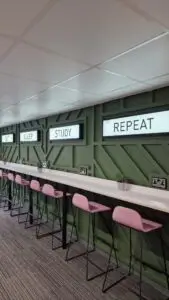
Classrooms and study areas benefit from cooler, calmer tones. Soft blues, muted greens, and warm neutrals are commonly specified because they are associated with reduced distraction and a calmer atmosphere, helping pupils focus during structured learning time.
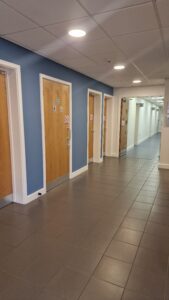
Corridors, stairwells, and transition spaces can accommodate bolder, more energising colour, because pupils move through these areas rather than working in them. These spaces also serve as orientation points within the building, and thoughtful colour use can assist with wayfinding.
Sports halls, dining areas, and social spaces often suit warmer tones or neutral bases with branded accent colours. These areas see the highest footfall, the greatest variation in use, and consequently require the most durable paint specifications.
A decorator brought in purely to apply what is specified without understanding the reasoning may produce technically clean work that is functionally wrong for the space. Experience in educational settings means understanding the purpose behind the specification, not just executing the application.
Durability Requirements Are More Demanding Than in Most Commercial Settings
Schools are among the most demanding environments a painted surface can be exposed to. Corridors experience hundreds of pupils passing through daily. Classroom walls absorb contact from bags, hands, chairs, and furniture. Dining areas are subject to spillages and daily cleaning. The paint system specified for a school must be able to withstand all of this without failing within months of application.
Standard emulsion paints, even quality commercial grades, are not adequate for the bulk of a school’s painted surfaces. High-opacity, scuff-resistant formulations are designed specifically for environments where washability and durability are non-negotiable. These products allow surfaces to be cleaned repeatedly, including with diluted cleaning solutions, without the finish breaking down or discolouring.
Getting the product specification wrong in a school means premature deterioration, visible marking within weeks, and a return to site for remedial work long before a reasonable maintenance cycle would dictate. The cost implications of under-specifying are significantly higher than the marginal difference in product cost at the outset.
Low-VOC Paint Specification Is More Critical When Children Are Present
Volatile Organic Compounds (VOCs) are the solvents present in many paints that evaporate as the paint dries and cure. They are responsible for the characteristic smell of fresh paint. In adult commercial environments, low-VOC paints are advisable. In schools, they are essential.
Children’s respiratory systems are still developing, making them more susceptible to irritation from airborne chemicals than adults. In any space where pupils will be present, or will return quickly after works are completed, low-VOC water-based formulations should be specified as standard. This is not an optional upgrade. It is the baseline for responsible work in an educational setting.
The added advantage of modern low-VOC water-based paints is their rapid drying time, which directly supports working within tight school holiday windows. Both requirements point in the same direction.
Safeguarding Compliance Is a Prerequisite, Not an Afterthought
Any contractor working on a school site, even outside of school hours, must hold current DBS (Disclosure and Barring Service) clearance for all personnel entering the premises. This is a statutory safeguarding requirement for work in educational settings, and it is non-negotiable.
Responsible education decorating contractors will confirm DBS status before any site visit and provide documentation to the school’s designated safeguarding lead as part of the pre-contract process. Schools are equally responsible for verifying this before granting site access. If a contractor is unable to provide current clearance for their team, they should not be appointed for educational work.
Beyond DBS, the provision of Risk Assessment and Method Statements (RAMS) in advance of any works is standard practice. This allows the school’s health and safety officer to review contractor procedures before works begin, preventing administrative delays on the day of mobilisation.
Conclusion
School decorating is a specialism for good reason. The combination of safeguarding requirements, demanding durability specifications, the need for low-VOC product selection, and an understanding of how colour and environment affect learning makes it distinct from general commercial painting work.
When a school commissions decorating works, the decision is not simply about who can apply paint most efficiently. It is about who understands the environment they are working in and can be trusted to get every element of it right.
Alan Cox Decorators has worked on educational projects across Leicestershire, Nottinghamshire, and the wider East Midlands for over 40 years. Our team works closely with headteachers and facilities managers to deliver projects on time, to the right specification, and with minimal disruption to the school. To discuss an upcoming project, contact us for a free site survey.