Summary: A hall, stairs and landing is the most demanding space in a house to decorate well, and the reason is access rather than skill. The wall above a staircase cannot be reached safely from a stepladder standing on the stairs, the space cannot be closed off while the work happens, and three levels have to be sequenced so that nothing already finished gets spoiled. This guide sets out how professional decorators approach it, and where the honest dividing line sits between a job you can take on yourself and one worth handing over.

Why this is not simply another room
Almost every other decorating job in a house happens inside a box. Four walls, a ceiling, a door you can shut, and furniture you can move into the middle and cover over. A hall, stairs and landing is none of those things.
It is a route rather than a room. It connects three levels, it is the only way between floors, and every person in the house passes through it many times a day. It is also the space that takes the most punishment: bags, coats, hands on walls, and every piece of furniture that has ever been carried in or out of the property.
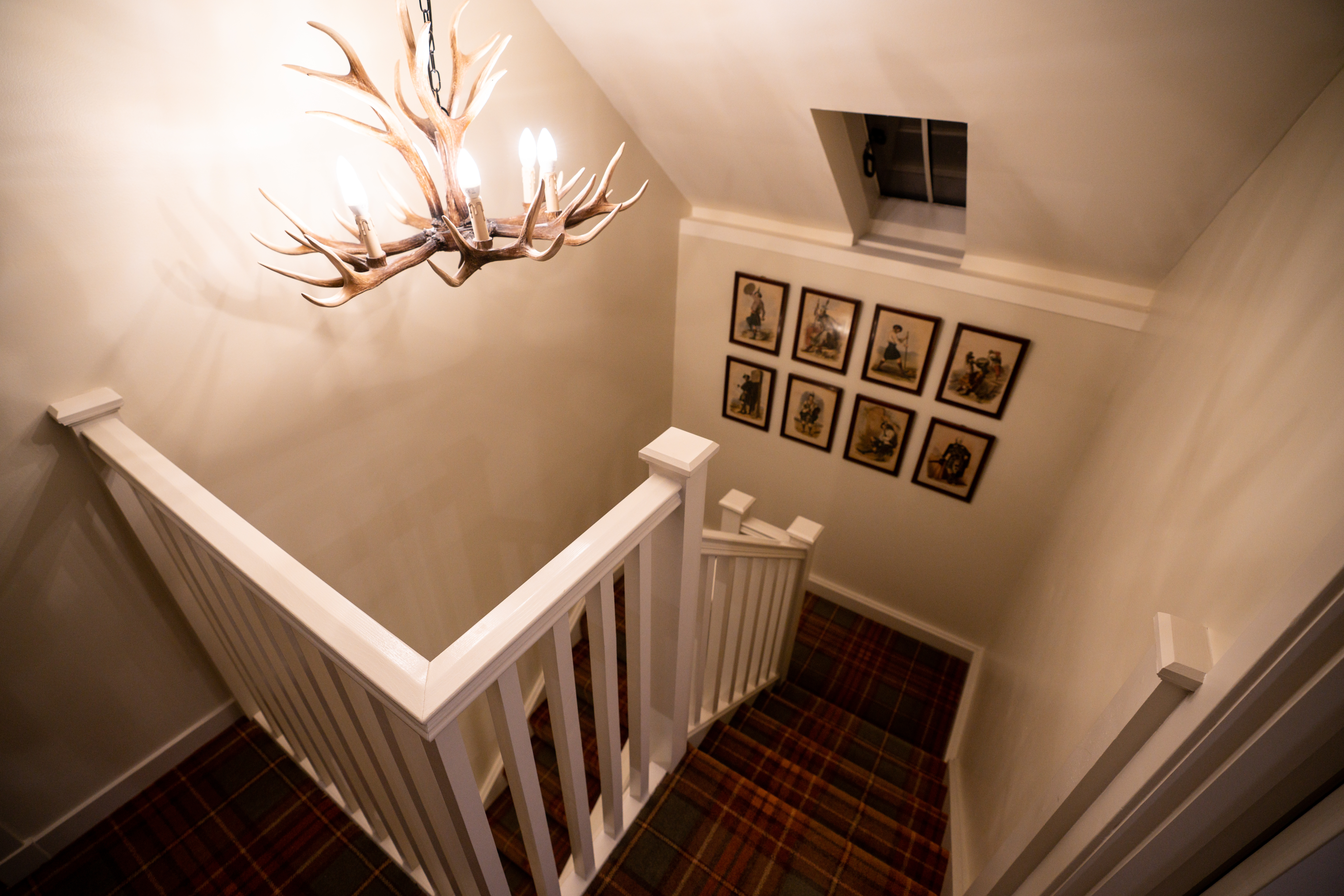
The surfaces sit at wildly different heights within a few feet of each other. Standing on the landing, you can touch one part of the wall comfortably, while another part of the same wall drops away below you to the hall floor. That single fact shapes the whole job.
Access is the decision that shapes everything else
The question that separates a good result from a poor one is how you intend to reach the high wall above the staircase and the stairwell ceiling above it. Everything else in this job is ordinary careful decorating. That part is not.
What the safety guidance actually says
The Health and Safety Executive is clear that ladders and stepladders are not banned under health and safety law, and that they can be a sensible and practical option for low-risk, short-duration tasks. The HSE is equally clear that they should not automatically be your first choice. The current UK guidance is LA455, Safe Use of Ladders and Stepladders, produced by the Ladder Association jointly with the HSE and published in July 2021, replacing the earlier HSE document INDG455.
Worth being precise about one thing. The Work at Height Regulations 2005 govern work activities. They do not apply to you decorating your own home. But the regulations exist because of physics, and the physics does not check whether you are being paid.
| The practical test: A stepladder needs a firm, level base. A staircase offers neither. Stair treads are not level relative to one another, the nosings are rounded, and the drop alongside is the full height of the stairwell.If you cannot set up so that both feet are on a level platform and you are not reaching sideways to work, the job needs different equipment. It does not need more care. |
What is used instead
There are proper answers to the stairwell problem, and decorators who do this regularly own the kit for it.
- A stairwell or combination ladder. Adjustable or independently extending legs let the frame stand level while the feet sit on different treads.
- A mobile access tower or staging built for the space. For a tall or open stairwell this is often the only sound answer, giving a level working platform with a guard rail.
- Extension poles. Useful for rolling the flat areas, but they do not solve cutting in at the ceiling line, which is the part that has to be done accurately and close up.
The improvisation to avoid is the scaffold board wedged between a stepladder and a stair tread. It is common, it looks workable, and it is where the serious falls in this job come from. The board flexes under load, the ladder foot sits on a rounded nosing, and there is nothing beside you but the drop.
The order of work across three levels
Ceilings, then walls, then woodwork is the standard professional sequence, and it holds here. It is set out in full in our guide to painting skirting boards and woodwork. What changes in a hall, stairs and landing is that you have three of everything, at three different heights, and the order in which you tackle them decides how much of your time goes into rigging rather than painting.
- Start at the highest point. The stairwell ceiling and the high wall go first, while the access equipment is set up for exactly that height.
- Do everything you can reach from each position before you move. Setting up twice to paint two surfaces at the same height is the most common way this job overruns.
- Work downwards. Landing, then the stairwell walls, then the hall at ground level, so that any drips land on surfaces you have not finished yet.
- Take the woodwork last, and take it across the whole space in one pass, so the trim reads as one consistent colour from the front door to the top of the stairs.
- Leave the handrail and spindles until the end. Everything else has to be carried past them.
Preparation in the most marked space in the house
General preparation is the same here as anywhere: fill, sand, clean, seal. What differs is what you are likely to find.
- Years of touch-ups. Hallway walls tend to carry a history of patch repairs in slightly different shades and sheens. Left alone, those patches read through a fresh coat as dull or shiny flashes, particularly in the raking light a stairwell tends to have.
- Knocks rather than fading. The damage here is physical. Dents and gouges from furniture manoeuvred round a turn in the stairs need filling and sanding flat, not simply painting over.
- Water staining. Landings sit below loft hatches and roof junctions, so old leaks show up here more than anywhere else in a house. Stains need sealing with a suitable stain block, or they will bleed back through the new paint within weeks.
Stripping wallpaper from a stairwell is the access problem all over again, and the plaster underneath is often the least loved in the property. If repairs go back to fresh plaster, that carries its own timetable before anything can be painted, which we cover in our guide to preparing and painting new plaster.
The details that change the size of the job
Two halls of the same floor area can be very different pieces of work. These are the variables that move it.
- The balustrade. This is where the hours go. A closed string with a panelled side is a fraction of the work of an open balustrade with turned spindles, because every spindle is cut in by hand and there is no way to speed that up without the finish showing it.
- The doors off the landing. A landing with two doors and a landing with six are not the same job. Each door has two faces, a frame and an architrave, and all of it is woodwork.
- The shape of the stairwell. A straight flight is straightforward to set up for. A half-landing, a winder, or a turn part way up means repositioning access equipment more than once.
- The under-stairs cupboard. Easy to leave off a scope and awkward to come back to once the rest is finished.
On which sheen to use where, see our guide to choosing the right paint finish. On how often these areas need doing again, our guide to how often you should repaint an interior sets out intervals room by room.
Living in the house while the work happens
This is the part homeowners consistently underestimate, and it is worth talking through before anyone starts.
- The stairs are the only route between floors. There will be periods when they cannot be used freely. That matters a great deal with young children, with anyone whose mobility is limited, and with pets.
- Access equipment left in position overnight. A tower or ladder standing in an unlit stairwell is a hazard at three in the morning. Agree in advance what gets moved at the end of each day and what stays.
- Dust travels further from a hallway than anywhere else. The space connects to every room in the house, so sanding dust reaches all of them unless doors are kept shut and the area is properly sheeted.
- The front door is also the working route. Deliveries, coats and shoes all live here, and so does everything being carried in and out.
- Drying time carries more weight here. In a spare bedroom you can shut the door and leave it. On a staircase you will brush past a wall, so coats need the time the tin says they need.
A decorator who works in occupied homes regularly will set this out before starting, so you know which parts of which days are affected rather than finding out on the morning.
Common mistakes, and how to avoid them
| Mistake | What happens | Better approach |
|---|---|---|
| Footing a ladder on a stair tread | No level base, a rounded nosing underfoot and a drop alongside. This is where the serious falls happen | Use equipment designed to stand level in a stairwell, or bring in someone who has it |
| Starting at the bottom | The high work is left until last and drips land on walls you have already finished | Start at the highest point and work downwards |
| Rigging and re-rigging repeatedly | Time goes into moving equipment instead of painting | Do everything reachable from each position before moving |
| Coating straight over old touch-up patches | Patches show through as dull or shiny flashes, worst in raking stairwell light | Fill, sand and seal so the whole wall takes the coat evenly |
| Ignoring a water stain on the landing | It bleeds back through the new paint within weeks | Seal with a suitable stain block first, after finding out where the water came from |
| Treating spindles as a small extra | A turned balustrade absorbs more hours than the walls do | Plan and price the balustrade as a task in its own right |
| Sheeting the hall floor only | Sanding dust reaches every room leading off the hall and landing | Sheet the full space and keep the doors closed throughout |
When it is worth calling a professional
Plenty of people paint the lower part of their own hallway and get a result they are pleased with. The point at which it stops being a sensible weekend job is fairly clear.
- The high wall above the staircase or the stairwell ceiling is included
- There is an open balustrade with turned spindles
- The stairwell has been papered and needs stripping back
- The house is occupied and the disruption needs managing rather than simply endured
- You do not own, and do not want to hire and learn to rig, equipment that will stand level on a staircase
Access is the honest dividing line. The rest of this job is ordinary decorating done patiently. The high work is a different thing, and it is not worth an injury to save a day.
Arrange a quote for your hall, stairs and landing
| Thinking about getting yours done? Alan Cox Decorators prepares and decorates halls, staircases and landings for homes across Leicester, Loughborough, Coalville, Markfield, Nottingham, Derby and the wider East Midlands. We are members of the Painting and Decorating Association and hold public liability insurance. Call 01530 249799 or request a free site survey. You will receive an itemised quotation by email before any work begins, so you can see exactly what is covered before you commit. |
For what a proper quotation should contain, and the questions worth asking before you accept one, see our guide to what to expect from a decorating quote. You can also see our full range of domestic decorating services.